
A Competency Demonstration Report (CDR) is not a normal “project report.” It’s a structured competency document that Engineers Australia (EA) uses to assess whether your skills match Stage 1 competency standards for your nominated occupation. Even strong engineers get poor outcomes because of avoidable mistakes—usually related to structure, competency mapping, evidence, and originality. Below are the Top 10 common mistakes in writing CDR reports for EA and exactly how to fix them.
Quick reminder: What EA expects in a CDR
Most applicants under the CDR pathway will prepare:
- Three Career Episodes (each typically 1000–2500 words)
- Summary Statement (competency cross-referencing to paragraph numbers)
- CPD list (Continuing Professional Development)
1) Not following EA’s structure and headings
Why this causes trouble
EA wants assessors to quickly find the required parts and evaluate you consistently. If you mix sections, rename them randomly, or use a confusing layout, you create assessment friction.
Fix
- Follow EA’s “Career Episodes + Summary Statement + CPD” structure
- Use clear headings like:
- Career Episode 1: [Project Title]
- Career Episode 2: [Project Title]
- Career Episode 3: [Project Title]
Pro tip: You can see the Career Episode CDR Samples for every field.
2) Plagiarism or “template writing” (the biggest risk)
Why this causes trouble
EA checks originality and expects the writing to reflect your own work and communication skills. EA guidance also warns against having your Career Episodes or Summary Statement written by someone else.
Fix
- Write everything from your own experience (your projects, your decisions, your outcomes)
- Use samples only to understand format, never as copy material
- Run a similarity check before submission
3) Writing “We did…” instead of “I did…”
Why this causes trouble
EA is assessing your competency, not your team’s. EA specifically recommends emphasizing your personal role (e.g., “I designed, I investigated…”).
Fix
- Replace “we” with “I” wherever it’s your responsibility
- If it was a team project, explain your part clearly:
- “I calculated…”
- “I selected…”
- “I verified…”
4) Career Episodes read like a duty statement (not a narrative)
Why this causes trouble
A Career Episode is not your job description. Assessors need a specific engineering story—what happened, what you did, and what results you achieved.
Fix (simple formula)
Use a clean flow:
- Project background (short)
- Your role (clear)
- Engineering activity (detailed)
- Problems + solutions (strong)
- Outcomes (measurable)
Pro tip: Add numbers where possible: capacity, load, cost, timeline, output, efficiency, safety improvements, etc.
5) Weak competency mapping in the Summary Statement
Why this causes trouble
Your Summary Statement must cross-reference competency elements to specific paragraph numbers in your Career Episodes. EA explains that you must number paragraphs and map elements to where they appear.
Fix
- Number every paragraph in each Career Episode
- Use EA’s Summary Statement approach:
- “CE1 Paragraph 3.2 demonstrates …”
- “CE2 Paragraph 2.4 demonstrates …”
Pro tip: Don’t “force” mapping. First write strong episodes, then map honestly.
6) Too much technical material (tables, drawings, long calculations)
Why this causes trouble
EA guidance recommends not including excessive technical details like photos, big calculations, tables, etc. Career Episodes should be readable narratives of engineering work.
Fix
- Summarize calculations in words:
- what you calculated
- why you calculated it
- what decision it supported
- Mention standards/software briefly (don’t dump pages of formulas)
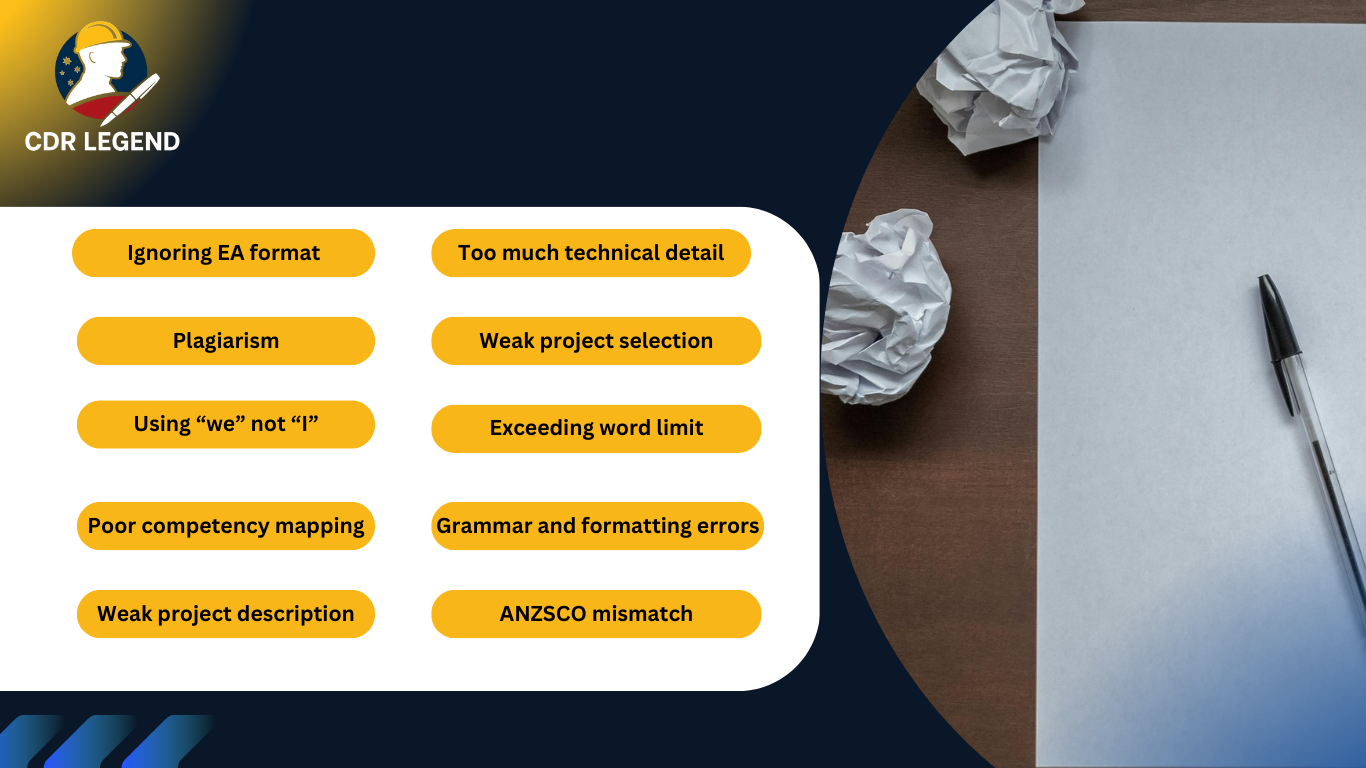
7) Choosing weak projects for Career Episodes
Why this causes trouble
If your episodes don’t show real engineering problem-solving, design decisions, risk/safety, stakeholder coordination, and professional practice, your competencies look thin.
Fix
Pick episodes that naturally show:
- design or analysis decisions
- dealing with constraints
- quality/safety/compliance
- teamwork + communication + leadership
- measurable outcomes
Pro tip: Avoid three episodes that are all the same type (e.g., three “site supervision only” stories). Diversity helps.
8) Exceeding word limits or writing “too short to prove competency”
Why this causes trouble
EA gives typical ranges to keep your writing focused. Too long becomes repetitive; too short becomes unconvincing. Each Career Episode is typically 1000–2500 words.
Fix
- Keep the background short
- Spend most words on:
- your actions
- engineering reasoning
- outcomes
Pro tip: If you’re over limit, remove “company history” and generic descriptions first.
9) Poor English, inconsistent formatting, and messy presentation
Why this causes trouble
EA expects professional written communication. Your CDR is also evidence of your communication ability.
Fix
- Use one font, one style, consistent headings
- Proofread twice:
- once for grammar/clarity
- once for formatting and numbering
Pro tip: Read your Career Episodes out loud—if a paragraph feels confusing, simplify it.
10) Missing employment evidence alignment (when your episode is based on work experience)
Why this causes trouble
EA’s pathway documentation notes that if your Career Episodes are based on engineering experience (work), you may need skilled employment evidence as part of the process.
Fix
- Ensure your claimed role/timeframe matches supporting employment documents
- Keep dates/titles consistent across:
- CV
- reference letters
- Career Episode timeline
Conclusion
Writing a CDR report for Engineers Australia (EA) is not just about describing your projects — it’s about clearly demonstrating your engineering competencies in line with EA’s Stage 1 standards. Even small mistakes such as weak competency mapping, plagiarism, poor structuring, or unclear Summary Statements can negatively impact your assessment outcome.
By avoiding these top 10 common mistakes in writing CDR reports for EA, you significantly improve your chances of a positive skills assessment. Remember, your CDR is your professional story — it must be authentic, structured, and competency-focused.
Need Professional Help With Your CDR?
If you are unsure about your Career Episodes, Summary Statement mapping, CPD formatting, or plagiarism risk — our expert CDR specialists are here to help.
We provide:
- Complete CDR writing services
- Career Episode drafting & restructuring
- Summary Statement competency mapping
- CPD preparation
- CDR review & plagiarism checking
- ANZSCO code selection guidance
Our team understands Engineers Australia requirements in detail and ensures your CDR is properly structured, original, and aligned with Stage 1 competency standards.
Get in touch with us today and let us help you submit a confident, assessment-ready CDR report.
FAQs
1) Can I use a CDR sample and “rewrite” it?
You can use samples to understand structure only. Your content must be your own experience and writing. EA warns against having episodes written by others and expects your own words.
2) What is the correct length for a Career Episode?
EA guidance commonly refers to 1000–2500 words per Career Episode.
3) Why do I need paragraph numbering?
Because the Summary Statement cross-references competency elements to specific Career Episode paragraphs.
4) Should I include drawings, tables, and calculations?
Avoid dumping heavy technical material. EA guidance recommends not including excessive technical details in Career Episodes.
5) What should my CDR focus on the most?
Your engineering actions, decisions, problem-solving, and results, mapped to Stage 1 competency standards.