

For engineers planning to migrate abroad, especially to countries like Australia and New Zealand, a skills assessment is one of the most important steps. Many applicants often get confused between CDR, RPL, and KA02 reports because each report has a different purpose and assessment authority. Understanding the difference between CDR, RPL and KA02 helps engineers choose the correct pathway and avoid unnecessary delays in their migration process. In this guide, we will explain what each report means, who needs it, and how they differ from each other.
Why Understanding CDR, RPL and KA02 is Important ?
Before applying for migration or professional recognition, engineering authorities need proof of your technical knowledge, qualifications, and work experience.
These reports help assessment bodies evaluate:
- Your engineering knowledge and technical skills
- Professional work experience and project involvement
- Ability to meet international engineering standards
- Competency required for skilled migration
Submitting the wrong report or poorly prepared documentation can lead to application rejection or delays. That’s why understanding the difference between CDR, RPL and KA02 is essential for engineers planning to work abroad.
What is a CDR Report?
A CDR (Competency Demonstration Report) is a technical report submitted to Engineers Australia for migration skills assessment. It is mainly required for engineers whose qualifications are not accredited under the Washington Accord. The purpose of a CDR report is to demonstrate that your engineering knowledge and professional experience meet Australian engineering standards.
Key Components of a CDR Report
A standard CDR report contains three main sections:
1. Continuing Professional Development (CPD)
CPD shows how engineers maintain and update their technical knowledge through training, workshops, seminars, or professional learning activities.
2. Three Career Episodes
Career episodes describe specific engineering projects or work experiences. Each episode explains the applicant’s personal role, technical contribution, and problem-solving ability.
Typical career episode structure includes:
- Introduction
- Background
- Personal Engineering Activity
- Summary
3. Summary Statement
The summary statement links the career episodes with the competency elements defined by Engineers Australia.
A well-written CDR report clearly highlights engineering skills, problem-solving ability, and professional competence.
What is an RPL Report?
An RPL (Recognition of Prior Learning) Report is mainly required for IT professionals applying through the Australian Computer Society (ACS).
The RPL report is designed for applicants who:
- Do not have a formal ICT degree
- Have qualifications in a different field
- Gained technical skills through work experience
The main goal of an RPL report is to demonstrate that your professional experience has helped you acquire the same knowledge as a formal ICT qualification.
Structure of an RPL Report
An ACS RPL report usually contains two sections.
Key Areas of Knowledge
In this section, applicants explain their understanding of fundamental ICT concepts and technologies. They must show how their experience helped them develop these skills.
Project Reports
The RPL report requires two detailed project reports that describe real projects the applicant has worked on.
Each project report typically includes:
- Project name and description
- Applicant’s personal responsibilities
- Technologies and tools used
- Results achieved
Unlike a CDR report, the RPL report focuses more on ICT knowledge and technical expertise rather than engineering competencies.
What is a KA02 Report?
A KA02 (Knowledge Assessment 02) Report is required for engineers applying for professional recognition in New Zealand.
This report is assessed by Engineering New Zealand (formerly IPENZ). It is used when an applicant’s engineering qualification is not recognized under the Washington Accord.
The KA02 report evaluates whether the applicant’s knowledge is equivalent to a Washington Accord accredited engineering degree.
KA02 Report Requirements
A typical KA02 report includes:
- Personal details and professional information
- Academic qualifications and training
- Detailed engineering work experience
- Demonstration of technical knowledge
- Evidence supporting competency claims
Compared to other reports, the KA02 assessment focuses more on knowledge equivalency rather than project storytelling.
Key Difference Between CDR, RPL & KA02
The difference between CDR, RPL and KA02 mainly depends on three factors:
- Profession
- Country of migration
- Assessment authority
Below is a simplified comparison.
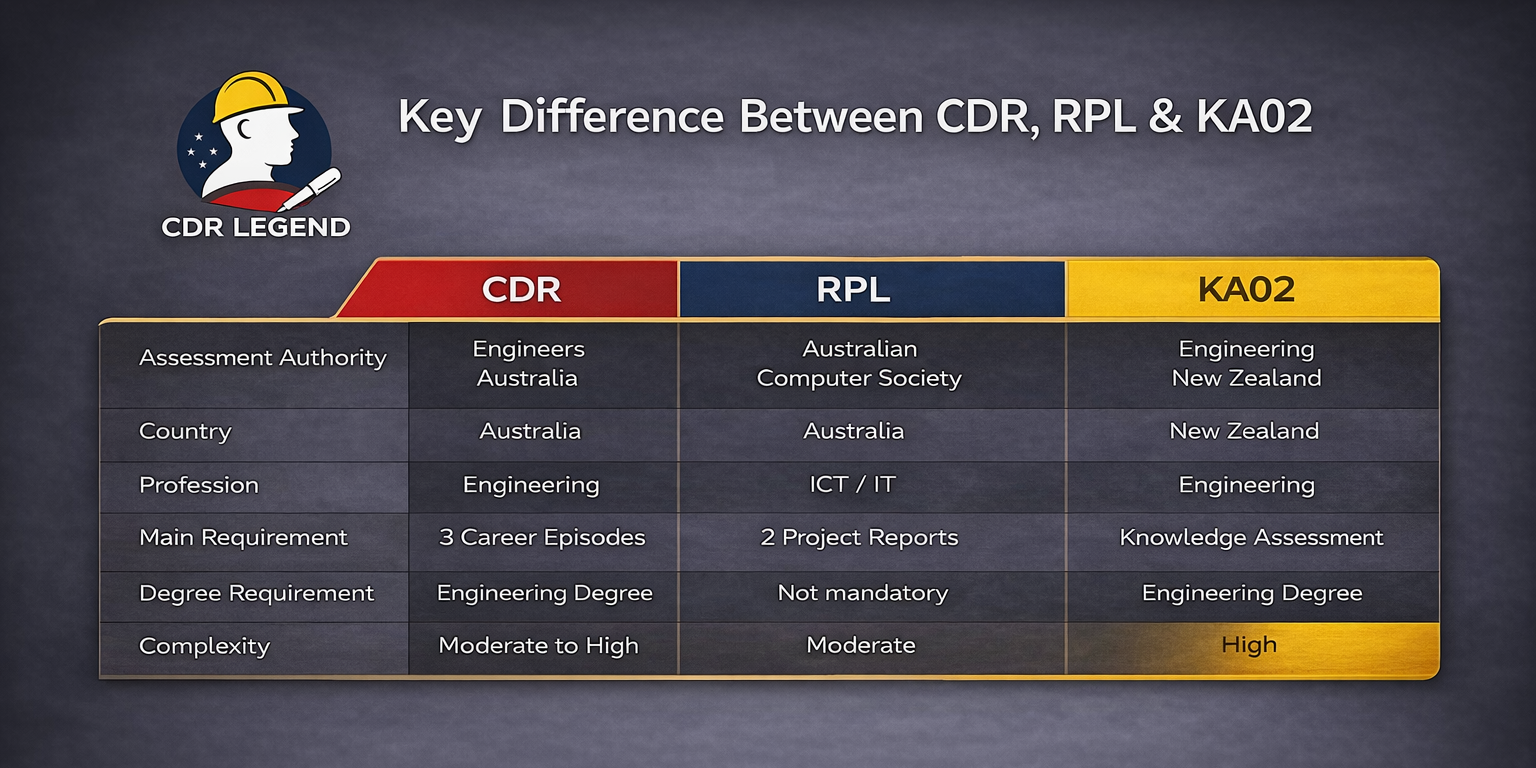
This table clearly explains the difference between CDR, RPL and KA02 reports and when each report is required.
How to Choose the Right Assessment Pathway
Choosing the correct assessment pathway depends on your qualification, profession, and migration destination.
Choose CDR if:
- You are an engineer applying for migration to Australia
- Your engineering degree is not Washington Accord accredited
Choose RPL if:
- You are an IT professional
- You do not have a formal ICT degree
- You gained skills through professional experience
Choose KA02 if:
- You want to work as an engineer in New Zealand
- Your engineering degree is not recognized internationally
Selecting the correct report is important because each authority evaluates different competencies and documentation requirements.
Tips for Writing Successful CDR, RPL and KA02 Reports
Preparing these reports requires careful planning and proper documentation. The following tips can help improve your chances of approval.
Understand the Assessment Guidelines
Always review the official guidelines of Engineers Australia, ACS, or Engineering New Zealand before preparing your report.
Avoid Plagiarism
All reports must be 100% original. Copied content may lead to immediate rejection.
Use Professional Language
Your report should be written in clear, formal, and technical language suitable for engineering or ICT professionals.
Highlight Your Personal Contribution
Assessment authorities want to understand your role in projects, not just the overall project description.
Provide Supporting Evidence
Include documents such as:
- Employment letters
- Project reports
- Certificates and training records
Strong evidence increases the credibility of your report.
Conclusion
Understanding the difference between CDR, RPL and KA02 is essential for engineers and IT professionals planning to migrate to Australia or New Zealand.
- CDR is required for engineers applying through Engineers Australia.
- RPL is designed for IT professionals applying through ACS without formal ICT qualifications.
- KA02 is used by engineers seeking professional recognition in New Zealand through Engineering New Zealand.
Choosing the right assessment pathway and preparing a well-structured report can significantly improve your chances of receiving a positive skills assessment.
FAQs – Difference Between CDR, RPL and KA02
1. What is the difference between CDR, RPL, and KA02?
The main difference between CDR, RPL, and KA02 lies in the profession, assessment authority, and country requirements. A CDR (Competency Demonstration Report) is required for engineers applying to Engineers Australia. An RPL (Recognition of Prior Learning) report is required for IT professionals applying through the Australian Computer Society (ACS) who do not have a formal ICT degree. A KA02 report is required for engineers seeking professional recognition in New Zealand through Engineering New Zealand.
2. Who needs to submit a CDR report?
Engineers who want to migrate to Australia and whose qualifications are not accredited under the Washington Accord must submit a CDR report to Engineers Australia. The CDR demonstrates the applicant’s engineering competencies, work experience, and technical knowledge through career episodes and a summary statement.
3. What is an RPL report used for?
An RPL report is used by IT professionals applying for a skills assessment through the Australian Computer Society (ACS). It is mainly required for applicants who do not have a formal ICT qualification but have gained relevant skills and knowledge through professional work experience.
4. What is the purpose of a KA02 report?
A KA02 (Knowledge Assessment 02) report is required by Engineering New Zealand to evaluate whether an engineer’s academic knowledge is equivalent to a Washington Accord accredited engineering qualification. It is mainly used by engineers whose degrees are not internationally recognized.
5. Which report is easier: CDR, RPL, or KA02?
The difficulty level depends on the applicant’s profession and experience. Generally, RPL reports are considered easier, while CDR reports require detailed career episodes and competency mapping. KA02 reports can be more challenging because they require a deep demonstration of engineering knowledge and academic equivalence.
6. Can the same report be used for Australia and New Zealand?
No, the same report cannot be used for both countries. CDR and RPL reports are used for Australian skills assessment, while KA02 reports are specifically required for engineering assessment in New Zealand.
7. How long does it take to prepare a CDR, RPL, or KA02 report?
The preparation time depends on the applicant’s experience and documentation. On average, a CDR report may take 1–3 weeks, an RPL report may take 1–2 weeks, and a KA02 report may take 2–4 weeks because it requires detailed evidence of engineering knowledge and competencies.