

When preparing a Competency Demonstration Report (CDR) for Engineers Australia, one of the most important steps is selecting the best engineering projects for career episodes. These projects form the core of your report and help assessors evaluate your engineering skills, technical knowledge, and professional competencies. Choosing the right projects can significantly increase your chances of receiving a positive skills assessment. In this guide, we will explain how to choose the best engineering projects for career episodes and what type of projects are most suitable for a successful CDR submission.
Why Choosing the Right Engineering Projects Matters ?
Your career episodes are not just simple descriptions of projects. They are detailed narratives that demonstrate how you applied engineering knowledge, solved technical problems, and contributed to project outcomes.
Engineers Australia evaluates your report based on several factors, including:
- Application of engineering principles
- Technical problem-solving ability
- Innovation and design skills
- Communication and teamwork
- Professional and ethical responsibility
Selecting the best engineering projects for career episodes helps you clearly demonstrate these competencies and present your professional abilities effectively.
Poor project selection can lead to weak career episodes and may even result in CDR rejection.
General Requirements for Career Episode Projects
Before selecting projects, it is important to understand the basic requirements for CDR career episodes.
Your projects should:
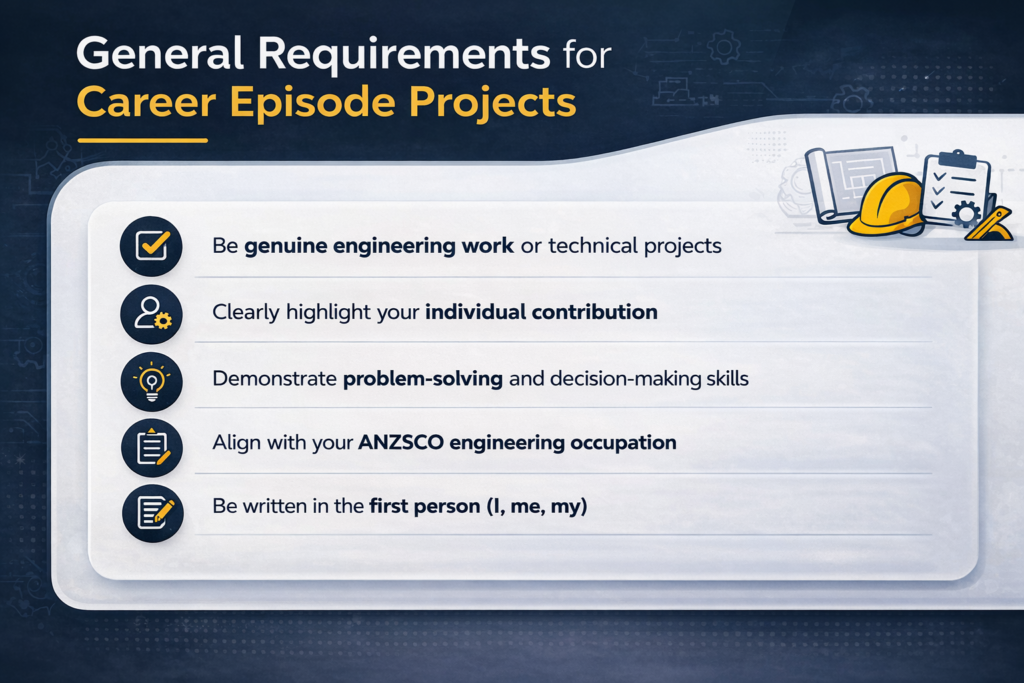
The goal is to show assessors how you personally applied engineering knowledge in real-world situations.
Best Engineering Projects for Career Episodes
The best engineering projects for career episodes usually involve complex tasks, technical decision-making, and measurable outcomes. Below are some examples of projects that work well for CDR reports.
Engineering Design Projects
Design-related projects are highly suitable for career episodes because they demonstrate your ability to apply engineering theories and technical knowledge.
Examples include:
- Structural design of buildings or bridges
- Electrical system design for industrial facilities
- Mechanical component design or product development
- Software system architecture for engineering applications
These projects show your analytical thinking, design skills, and technical expertise.
Process Improvement Projects
Process optimization projects demonstrate your ability to improve efficiency, reduce costs, and enhance performance.
Examples include:
- Manufacturing process optimization
- Energy efficiency improvements in industrial systems
- Production line automation
- Quality control improvements
Such projects highlight engineering analysis and problem-solving abilities.
System Implementation Projects
Implementation projects demonstrate practical engineering experience in real-world environments.
Examples include:
- Installation of electrical power distribution systems
- Implementation of automation or control systems
- Development of engineering software solutions
- Deployment of communication networks
These projects clearly show how engineers apply technical knowledge in practice.
Troubleshooting and Problem-Solving Projects
Projects that involve solving technical problems are excellent choices for career episodes.
Examples include:
- Diagnosing mechanical equipment failure
- Resolving electrical faults in power systems
- Debugging software engineering systems
- Improving system reliability or safety
These projects demonstrate your critical thinking and analytical problem-solving skills.
Key Criteria for Selecting the Best Projects
To choose the best engineering projects for career episodes, consider the following important criteria.
Individual Contribution
Engineers Australia focuses on your personal role, not the team’s overall achievement.
Select projects where you:
- Played a significant role
- Made engineering decisions
- Solved technical problems
- Contributed directly to project outcomes
Always highlight what you personally did in the project.
Level of Complexity
Choose projects with sufficient engineering complexity. Simple routine tasks may not demonstrate the required competencies.
Strong career episode projects usually involve:
- Technical calculations
- System design or analysis
- Engineering problem-solving
- Innovative solutions
Diversity of Skills
Your three career episodes should highlight different engineering competencies.
For example:
- One project may demonstrate design skills
- Another may show problem-solving ability
- A third may highlight project management or teamwork
This diversity helps assessors understand your overall engineering capability.
Alignment with ANZSCO Code
Your projects must match the engineering occupation you selected in your CDR application.
For example:
- Civil Engineers should include infrastructure or structural projects
- Mechanical Engineers should include machine design or mechanical systems
- Electrical Engineers should include power systems or electrical installations
Choosing projects aligned with your ANZSCO occupation strengthens your application.
Common Mistakes When Selecting Career Episode Projects
Many engineers make mistakes when choosing projects for their career episodes.
Avoid the following errors:
- Selecting projects with minimal personal involvement
- Using purely academic assignments with little technical depth
- Choosing unrelated projects outside your engineering field
- Repeating the same project in multiple career episodes
- Writing vague descriptions without technical details
Avoiding these mistakes will help create strong and convincing career episodes.
Tips for Writing Strong Career Episodes
After selecting the best projects, it is important to present them effectively.
Follow these tips:
Use First Person Writing
Always write using “I” statements such as:
- I designed the system
- I conducted the analysis
- I developed the solution
This clearly highlights your individual contribution.
Include Technical Details
Provide sufficient technical information such as:
- Engineering calculations
- Design methods
- Tools and software used
- Technical challenges and solutions
This demonstrates your engineering competence.
Quantify Your Results
Whenever possible, include measurable results such as:
- Reduced operational costs by 25%
- Improved system efficiency by 30%
- Increased production capacity
Quantifiable outcomes make your career episodes more convincing and professional.
Conclusion
Selecting the best engineering projects for career episodes is one of the most important steps in preparing a successful CDR report for Engineers Australia.
Your projects should clearly demonstrate your technical knowledge, problem-solving ability, and engineering competencies. By choosing projects with strong personal involvement, technical complexity, and measurable results, you can create powerful career episodes that increase your chances of receiving a positive skills assessment.
Careful project selection combined with proper CDR writing can significantly improve the overall quality of your report and help you achieve your migration goals.
FAQs – Best Engineering Projects for Career Episodes
1. What are the best engineering projects for career episodes in a CDR?
The best engineering projects for career episodes are those that demonstrate technical knowledge, problem-solving ability, and personal contribution. Suitable projects may include system design, process optimization, equipment troubleshooting, software development, or infrastructure development. These projects should clearly show your individual role and engineering decisions.
2. How many projects are required for CDR career episodes?
A Competency Demonstration Report (CDR) requires three career episodes, and each episode should be based on a different engineering project or work experience. These projects can come from academic studies, internships, or professional work experience.
3. Can academic projects be used in career episodes?
Yes, academic projects can be used in career episodes, especially for fresh graduates who have limited professional experience. However, the project should involve technical engineering work, problem-solving, and personal contribution rather than simple coursework.
4. What type of projects should be avoided in career episodes?
Projects that should be avoided include routine tasks, administrative work, projects with minimal personal involvement, or projects unrelated to your engineering discipline. Engineers Australia expects projects that demonstrate real engineering competencies and technical problem-solving.
5. Should career episode projects match the ANZSCO occupation?
Yes, the projects used in career episodes should match the ANZSCO occupation you selected for your CDR application. For example, civil engineers should include infrastructure or structural projects, while electrical engineers should focus on power systems or electrical installations.
6. Can the same project be used in multiple career episodes?
No, the same project should not be repeated in multiple career episodes. Each episode must describe a different engineering project or experience to demonstrate a variety of competencies and skills.
7. How detailed should career episode projects be?
Career episode projects should be detailed and technically descriptive, usually around 1000–2500 words per episode. They should include the project background, your personal engineering activities, technical challenges, solutions implemented, and the final results achieved.