
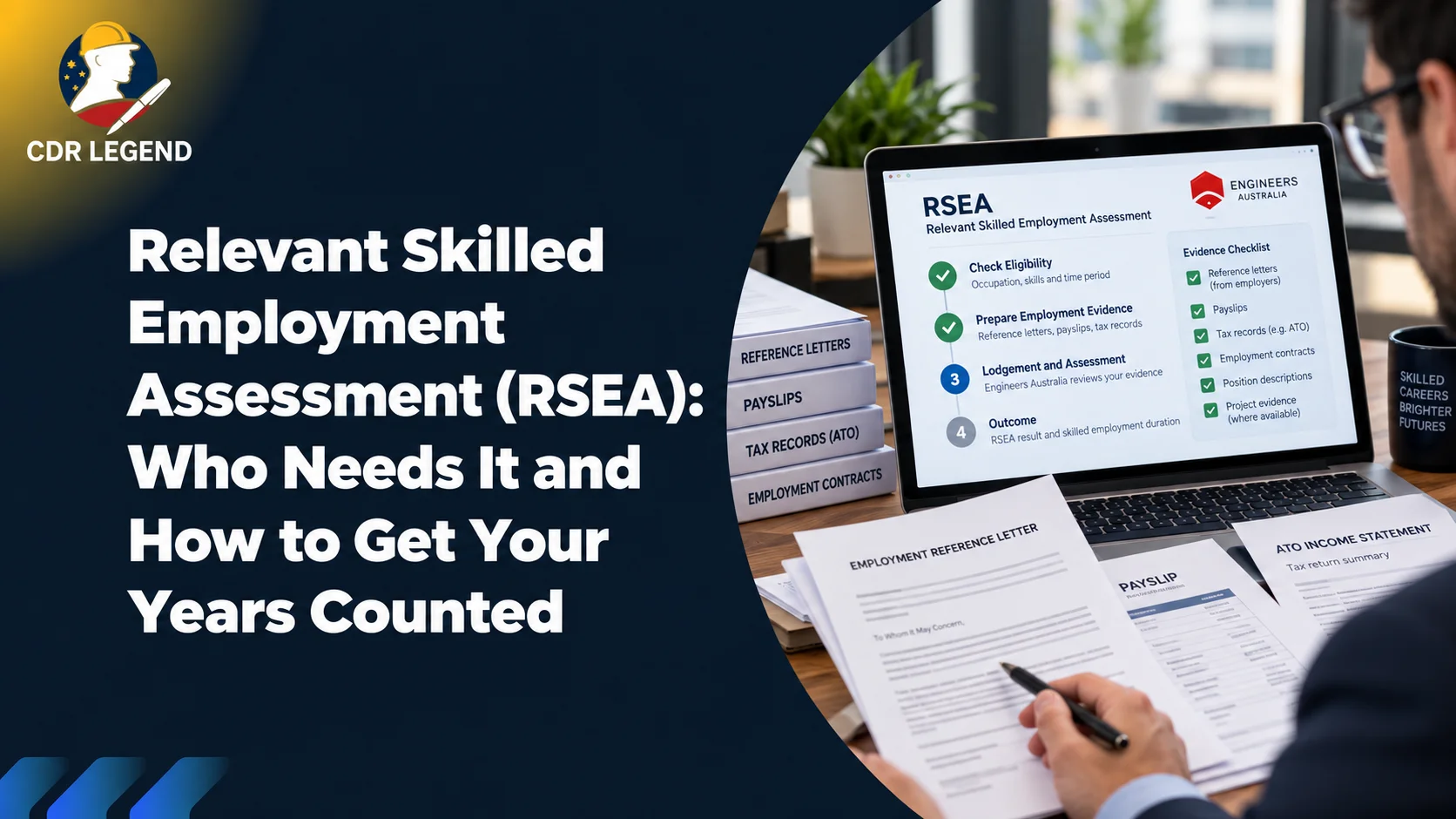
A Relevant Skilled Employment Assessment (RSEA) is the service Engineers Australia uses to decide how many years of your engineering experience actually count toward Australian skilled migration. It is not part of a standard CDR assessment. If you do not apply for it, Engineers Australia assesses your qualification — and says nothing at all about your employment.
That distinction matters more than most applicants realise, because skilled employment is worth up to 20 points on the points test. This guide explains who needs an RSEA, who is required to have one, what evidence Engineers Australia accepts, and the mistakes that cause engineers to lose years they genuinely worked.
What Is a Relevant Skilled Employment Assessment?
An RSEA is an additional, paid assessment in which Engineers Australia reviews your employment history and formally determines which periods were skilled engineering employment relevant to your nominated occupation.
The outcome letter states the periods assessed as relevant. The Department of Home Affairs then uses that assessment when you claim skilled employment points in your Expression of Interest.
It is a separate service from your migration skills assessment. You can apply for it at the same time as your CDR or accredited-pathway application, or separately afterwards.
What an RSEA is not
- It is not a second skills assessment — it does not re-evaluate your qualification.
- It is not an assessment of whether your CDR career episodes were well written.
- It does not create points by itself. It verifies the years so you can claim the points your experience already supports.
Who Needs an RSEA?
There are three distinct situations, and engineers routinely place themselves in the wrong one.
1. Mandatory – Engineering Managers
If you are seeking assessment as an Engineering Manager, the Relevant Skilled Employment Assessment is compulsory rather than optional. The occupation is defined by managerial responsibility over engineering functions, so Engineers Australia cannot assess it on qualification alone. If this is your nominated occupation, treat RSEA as part of the application, not an add-on.
2. Strongly recommended – anyone claiming employment points
For every other engineering occupation, RSEA is optional in the technical sense. In practice it is close to essential if you intend to claim points for skilled employment. Without an EA assessment of your employment, a points claim rests on your own documentation and your own interpretation of what counts — and that is a weak position at the visa stage, where an incorrect claim is not just a lost point but a credibility problem.
3. Not needed – applicants not claiming employment points
If you are a recent graduate with under three years of experience, your overseas employment will score zero points regardless, and paying for RSEA adds cost without changing your score. The same applies if you already reach the 20-point employment cap through Australian experience alone.
Why RSEA Matters: The Points Arithmetic
Skilled employment is one of the largest discretionary blocks of points available. These are the bands that apply to the subclass 189, 190 and 491 visas:
| Years of skilled employment | Overseas (outside Australia) | In Australia |
| Less than 1 year | 0 points | 0 points |
| At least 1, less than 3 years | 0 points | 5 points |
| At least 3, less than 5 years | 5 points | 10 points |
| At least 5, less than 8 years | 10 points | 15 points |
| At least 8 years | 15 points | 20 points |
Three rules shape how this plays out:
- Overseas and Australian employment are scored separately, but the combined total is capped at 20 points.
- Only employment in your nominated occupation, or one closely related to it, is counted.
- Only the ten years before your invitation are considered, and the work must be paid.
The practical stakes. An engineer with seven years of overseas experience is claiming 10 points. If Engineers Australia assesses only four of those years as relevant — because two early years were pre-qualification and one was in a role outside the occupation — the claim drops to 5 points. Five points is frequently the difference between an invitation and an indefinite wait in the pool. Finding this out through an RSEA before you lodge an EOI is uncomfortable; finding it out after lodging a visa application is considerably worse.
What Documents Does Engineers Australia Require for RSEA?
Employment Evidence Required by Engineers Australia
This is where most RSEA applications fail. Engineers Australia requires evidence for every employment period you claim, and it wants that evidence from two independent directions.
Evidence From Your Employer
Evidence From Independent Third Parties
Primary documents alone are not enough. Engineers Australia also wants corroboration from sources your employer does not control.
Statutory declarations and affidavits are not accepted as assessment evidence. This catches out a large number of applicants from South Asia and the Middle East, where a sworn affidavit is a normal substitute when a former employer has closed or will not cooperate.
It will not work here — you need documentary evidence of the kind listed above.
If you were self-employed
Self-employed periods are assessed on their own basis and need a different evidence set: business registration documents, tax filings in the business name, client contracts, invoices, and evidence that the engineering work performed matches your nominated occupation. Expect this to be scrutinised more closely than salaried employment, and prepare accordingly.
The Most Common Reasons Years Get Rejected
| Reason | What happens | How to prevent it |
| Duties do not match the ANZSCO definition | The period is excluded entirely | Have the reference letter written against the ANZSCO duty statement for your occupation |
| Generic reference letter | Period excluded or queried | Replace “responsible for engineering activities” with specific, named engineering duties |
| Work performed before qualification | Usually excluded | Check the qualification date against your employment start date before claiming |
| Missing secondary evidence | Period not recognised | Supply tax, payslip or contribution records for every claimed period |
| Statutory declaration used as proof | Not accepted at all | Source documentary evidence; a declaration cannot substitute |
| Unpaid, stipend or scholarship work | Excluded | Only paid employment at market or salaried rates counts |
| Gaps unexplained in the CV | Queries and delay | Submit a chronological CV covering every period, including gaps |
The pattern behind nearly all of these: the employment was real, but the paperwork was written for a different purpose. A reference letter drafted for a visa application, a bank or a new employer will not describe your duties the way Engineers Australia needs to see them. The letter has to be prepared with the ANZSCO definition in front of you.
How Much Does RSEA Cost and How Long Does It Take?
Engineers Australia charges RSEA as an additional service alongside your migration skills assessment, or as a standalone assessment if you have already been assessed.
| Service | Fee (excl. GST) | Fee (incl. GST) |
| Separate relevant skilled employment assessment | AUD $485 | AUD $533.50 |
| CDR assessment plus relevant skilled employment assessment | AUD $1,375 | AUD $1,512.50 |
| Separate RSEA plus overseas engineering PhD assessment | AUD $760 | AUD $836 |
GST applies to applicants in Australia; overseas applicants pay the lower figure. Fees are reviewed annually, so confirm the current amount on the Engineers Australia fees page before you pay.
Applying for RSEA at the same time as your skills assessment is both cheaper and faster than applying separately afterwards. If there is any realistic chance you will claim employment points, bundle it from the start.
How to Prepare a Strong RSEA Application
Step 1: Confirm your ANZSCO occupation first
Every judgment in an RSEA is made against your nominated occupation’s duty statement. Choosing the occupation after collecting your evidence means your evidence was gathered against the wrong benchmark.
Step 2: Map each role to the duty statement
Take the ANZSCO description for your occupation and, role by role, identify which duties you genuinely performed and what evidence proves it. Periods that cannot be mapped should not be claimed — claiming them weakens the application without adding points.
Step 3: Get reference letters rewritten before you request signatures
Approach former employers once, with a draft that already states your duties in the right form. Going back a second time because the first letter was too vague is usually harder than getting it right initially, and sometimes impossible.
Step 4: Collect secondary evidence for every single period
Work backwards through tax years, provident fund statements and bank records now, while you still have access. Former employees routinely lose portal access after leaving.
Step 5: Submit a complete application
An RSEA with missing documentation is not assessed sympathetically — periods submitted without the full evidence set are simply not recognised. A complete application also avoids a request for further information, which restarts your waiting time.
Get Your Years Assessed Properly
At CDR Legend, our RSEA consultation covers the full process: confirming your eligibility against the ANZSCO definition of your nominated occupation, identifying which employment periods are realistically claimable, guiding you through the documentation Engineers Australia requires, and assisting you in drafting duty statements for your experience letters so they meet EA requirements before you ask an employer to sign.
We also review the documents you already hold, so you know which periods are solid and which need strengthening before anything is submitted.
Talk to our team about your employment history
Frequently Asked Questions
Is the Relevant Skilled Employment Assessment mandatory?
It is mandatory for applicants seeking assessment as an Engineering Manager. For all other engineering occupations it is optional, but it is strongly recommended for anyone claiming skilled employment points on the points test.
How much does RSEA cost with Engineers Australia?
A separate relevant skilled employment assessment is AUD $485 excluding GST, or $533.50 including GST. Bundled with a CDR assessment it is AUD $1,375 excluding GST, or $1,512.50 including GST. Confirm current fees on the Engineers Australia website before applying.
How many points is skilled employment worth?
Overseas skilled employment is worth up to 15 points and Australian skilled employment up to 20 points, but the combined total is capped at 20 points. Only work in your nominated or a closely related occupation within the last ten years counts.
What documents are required for an RSEA?
You need primary evidence from your employer — a detailed reference letter on letterhead, dates, duties, hours, salary, an organisational chart and a company profile — plus secondary evidence from independent sources such as tax records, payslips, bank statements and social security or provident fund contributions.
Will Engineers Australia accept a statutory declaration or affidavit?
No. Statutory declarations and affidavits are not accepted as assessment evidence. You must provide documentary evidence of employment from your employer and from independent third parties.
Can I apply for RSEA after my skills assessment is complete?
Yes, you can apply for a separate relevant skilled employment assessment afterwards. Applying at the same time as your skills assessment is usually cheaper and faster, so bundle it if you expect to claim employment points.
Does experience before my engineering degree count?
Generally no. Employment performed before you completed the qualification being assessed is usually excluded from the relevant skilled employment period.
Can self-employment be assessed for RSEA?
Yes, but it is assessed on a different basis and needs business registration documents, tax filings in the business name, client contracts and invoices to establish both the employment and the engineering nature of the work.