

If you’re applying for Australian skilled migration, your employment reference letter is one of the most important documents in your skills assessment and visa file. It’s not just a “recommendation”—it’s a formal, verifiable proof of employment that must clearly show:
- Who employed you ?
- When you worked there ?
- Your job title and employment type ?
- What duties you actually performed (aligned with your nominated occupation/ANZSCO) ?
- Who can verify it (authorized signatory + contact details) ?
Assessing bodies like ACS require employment references on company letterhead and signed/dated by an authorized person (with specific evidence expectations).
For Engineers Australia, reference letters often need extra details such as employment type, pay rate, and detailed duties.
Below is a clean, step-by-step guide + sample you can adapt for your own occupation.
What is an Employment Reference Letter for Australian Immigration?
An employment reference letter for Australian immigration is an official letter (usually from HR, manager, or supervisor) that confirms your work experience and describes your role and responsibilities in a way that an assessing authority can evaluate.
This letter is commonly used for:
- ACS Skills Assessment (ICT occupations)
- Engineers Australia (EA) Skills Assessment
- Other assessing bodies depending on your occupation and pathway
Why this letter matters (and what many applicants miss)
A strong employment reference letter helps prove your claimed experience—but here’s the key:
A reference letter alone is usually not enough for your visa stage. The Department of Home Affairs states you must provide detailed proof of employment history, and a work reference alone isn’t enough. You may need supporting evidence like payslips, bank statements, or tax records.
So think of your reference letter as the core document, supported by secondary evidence.
Who should write the employment reference letter?
Best options (in order):
- Direct Manager / Supervisor (ideal)
- HR Manager / HR Department
- Director / Owner (especially for small companies)
The writer should be someone who can be verified if the authority contacts them.
Tip: Avoid “friend-like” letters. Immigration/skills assessment letters must be formal, factual, and verifiable.
Employment Reference Letter Requirements (ACS + Engineers Australia)
ACS (Australian Computer Society) – key expectations
ACS states you should provide an employment reference letter for each relevant employer, and it must be:
- On company letterhead
- Signed and dated by an authorized person (digital signatures may be accepted with verification)
ACS also publishes detailed requirements in their guidance for statutory declarations/affidavits (often used if an employer cannot provide a compliant letter). This guidance includes items like:
- Employer name/address + company website
- Your full name
- Letter date
- Start and end dates in DD/MM/YYYY
- Employment status and minimum hours/week
- Annual salary (before tax)
Engineers Australia (EA) – key expectations
Engineers Australia’s guidance for employment evidence commonly expects a reference letter on letterhead including:
- Period of employment
- Employment type (full-time/part-time)
- Pay rate
- Job title
- Detailed duties performed
Step-by-step: How to write a perfect employment reference letter
1) Use proper company letterhead
Your letter should be on:
- Official letterhead (company name, address, phone, website, email)
- Include business registration info if available (optional but helpful)
2) Start with a clear, credible introduction (short)
Include:
- Who the writer is (name, designation)
- Relationship to the employee (line manager, supervisor, HR)
- How long they supervised/managed you
- Company name + your job title
Keep it factual and under ~80–120 words.
3) Add employment details in a “proof-friendly” format
Include these as a small block (easy to scan):
- Employee full name (as passport)
- Job title
- Employment type (full-time/part-time/contract)
- Hours per week
- Work location (city, country)
- Start date and end date (DD/MM/YYYY)
- Salary (annual or monthly; before tax) + benefits if relevant
4) Write duties that match your nominated occupation (ANZSCO-aligned)
This is where most applications fail.
Write 8–12 bullet points that:
- Sound like real work (not copied textbook lines)
- Mention tools/tech/processes you used
- Show scope, responsibility, and outcomes
- Align with your occupation tasks
Important: Don’t paste ANZSCO tasks word-for-word. Paraphrase honestly based on what you actually did.
5) Add projects + achievements (evidence-based)
Add 2–4 bullets:
- Key projects you worked on
- Your contribution
- Measurable results (time saved, cost reduced, uptime improved, etc.)
6) Verification block (must-have)
End with:
- Writer’s full name + title
- Work email + phone
- Signature (wet or valid digital)
- Company stamp (if available)
- Date of issue
EA notes letters should be endorsed/signed by an issuing manager/HR/supervisor and include contact info.
Employment Reference Letter Template
[Company Letterhead]
Date: DD/MM/YYYY
To Whom It May Concern,
This is to confirm that [Employee Full Name as per Passport] (Employee ID: [optional]) was employed with [Company Legal Name] as a [Job Title] from [Start Date – DD/MM/YYYY] to [End Date – DD/MM/YYYY / Present]. I, [Referee Full Name], am the [Referee Job Title] at [Company Name] and I directly supervised/managed [Employee Name] from [Month/Year] to [Month/Year].
Employment Details
- Position Title: [Job Title]
- Employment Type: Full-time / Part-time / Contract
- Hours Worked: [e.g., 38] hours per week
- Work Location: [City, Country]
- Salary: [e.g., AUD/PKR ___ per annum/month] (before tax) + [benefits if applicable]
Key Duties and Responsibilities
During their employment, [Employee Name] performed the following duties:
- [Duty aligned with ANZSCO — real task + tools/process]
- [Duty — scope + responsibility]
- [Duty — stakeholder/team collaboration]
- [Duty — reporting/documentation/compliance]
- [Duty — problem solving/improvement]
- [Add 2–6 more duties as needed]
Key Projects / Achievements (Optional but recommended)
- [Project Name] – [What you did + outcome]
- [Project Name] – [What you did + outcome]
Performance & Conduct
Throughout their tenure, [Employee Name] demonstrated professionalism, strong communication skills, and consistent performance. They met deadlines, collaborated effectively with teams, and delivered quality outcomes in their role.
If you require any further information, please contact me using the details below.
Sincerely,
[Signature]
[Referee Full Name]
[Referee Position/Title]
[Company Name]
Email: [work email] | Phone: [work phone]
Company Stamp (if available)
Checklist: Before you submit your reference letter
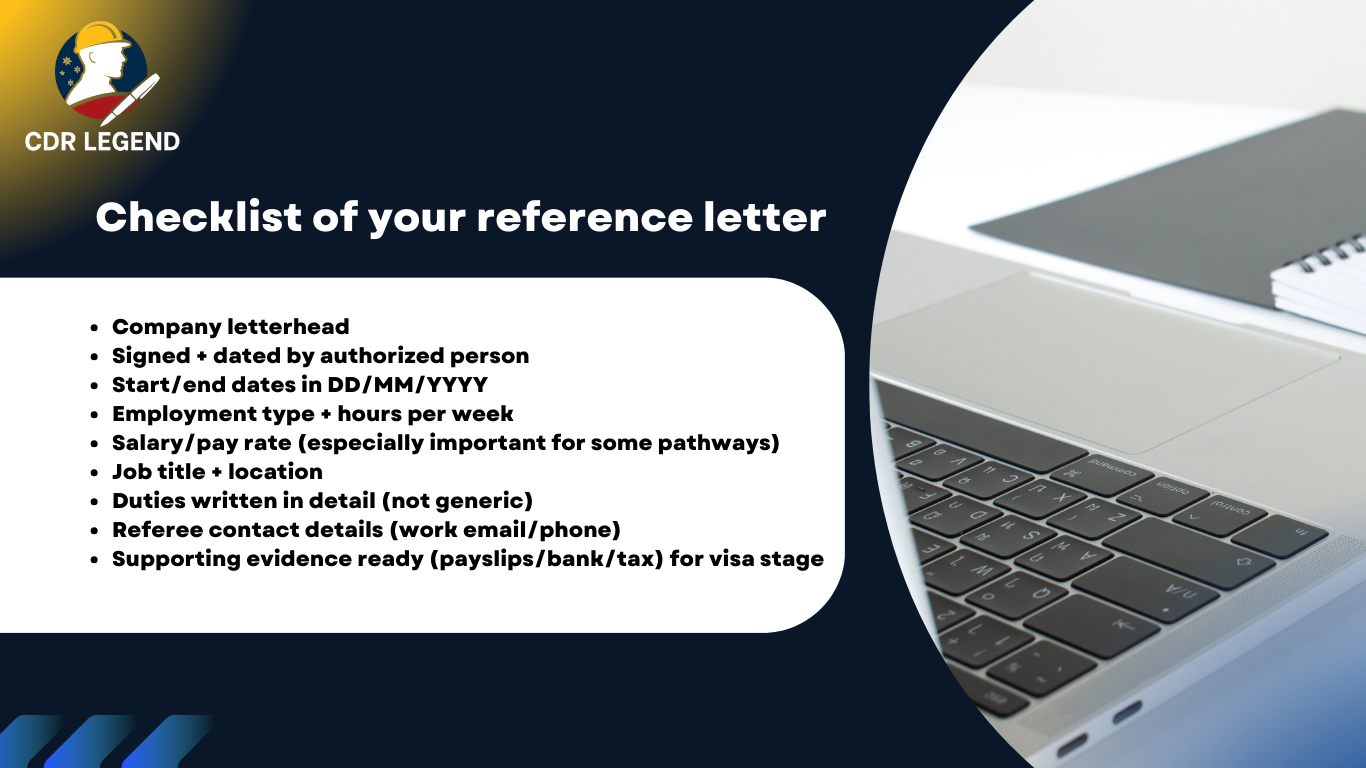
Make sure your employment reference letter includes:
- Company letterhead
- Signed + dated by authorized person
- Start/end dates in DD/MM/YYYY
- Employment type + hours per week
- Salary/pay rate (especially important for some pathways)
- Job title + location
- Duties written in detail (not generic)
- Referee contact details (work email/phone)
- Supporting evidence ready (payslips/bank/tax) for visa stage
Common mistakes that cause delays or refusal-like outcomes
1) Duties are too general
Bad: “Responsible for engineering tasks and reporting.”
Good: “Prepared design calculations, reviewed shop drawings, coordinated with the site team, and ensured compliance with project specs.”
2) Missing hours, salary, or employment type
Many applicants forget these. But ACS guidance (in supporting evidence format) explicitly mentions hours and salary. EA guidance frequently expects employment type and pay rate.
3) Not verifiable signatory
A Gmail/Yahoo email for the referee looks weak. Prefer official domain email.
4) Copy-pasting ANZSCO wording
Paraphrase and keep it real. Authorities can detect templated text.
Conclusion
A “perfect” employment reference letter for Australian immigration is one that is verifiable, properly formatted, and clearly aligned with your nominated occupation—with enough detail for ACS/EA (or your assessing authority) to assess your experience confidently. Use the template above, keep duties realistic and specific, and support it with evidence for the visa stage.
FAQs
1) What should be included in an employment reference letter for Australian immigration?
At minimum: letterhead, dates, job title, employment type, hours/week, salary, duties, and authorized signature/contact details. ACS and EA both emphasize letterhead + proper verification details.
2) What date format should I use?
Use DD/MM/YYYY (commonly required in skills assessment evidence formats).
3) Can a colleague write my employment reference letter?
It’s best from HR/manager/supervisor. If an employer cannot provide it, some pathways allow alternative evidence (like statutory declarations) depending on the assessing authority—always follow the official guidance for your authority.
4) How long should an employment reference letter be?
Usually 1–2 pages. The goal is detail + clarity, not length.
5) Is the reference letter enough for the visa application?
Often no. Home Affairs says you should provide detailed proof like payslips/bank/tax records, and a work reference alone isn’t enough.
6) Do I need a separate letter for each employer?
Yes—generally you should provide a reference letter for each relevant employment episode (especially for ACS skills assessment).