

Applying for an ACS Skills Assessment through the Recognition of Prior Learning (RPL) pathway can be a game-changer for ICT professionals who do not hold a formal ICT qualification. However, many applicants face disappointment when their ACS RPL report gets rejected. Every year, thousands of RPL applications are declined due to avoidable mistakes. Understanding the exact reasons for RPL rejection from ACS is the first step toward securing a positive outcome.
In this blog, we’ll break down the most common reasons for ACS RPL rejection, explain why they happen, and share practical tips to avoid them—so you can submit a strong, compliant, and approval-ready RPL report.
What Is an ACS RPL Report?
The Recognition of Prior Learning (RPL) is an assessment pathway provided by the Australian Computer Society (ACS) for applicants who:
- Do not hold an ICT qualification
- Hold a non-ICT degree with limited ICT content
- Have gained ICT skills through professional work experience
The RPL report allows candidates to demonstrate ICT knowledge, skills, and competencies acquired through real-world experience rather than formal education.
An ACS RPL submission typically includes:
- Two detailed Project Reports
- Key Areas of Knowledge (KAoK) explanation
- Employment evidence and reference letters
Eligibility Criteria for ACS RPL
You may apply for an ACS RPL assessment if:
- You do not hold an ICT degree but have at least 5 years of relevant ICT work experience
- You do not hold any tertiary qualification and have at least 8 years of relevant ICT work experience
Meeting the experience requirement alone is not enough—quality, relevance, originality, and documentation play a critical role in approval.
Top Reasons for RPL Rejection from ACS
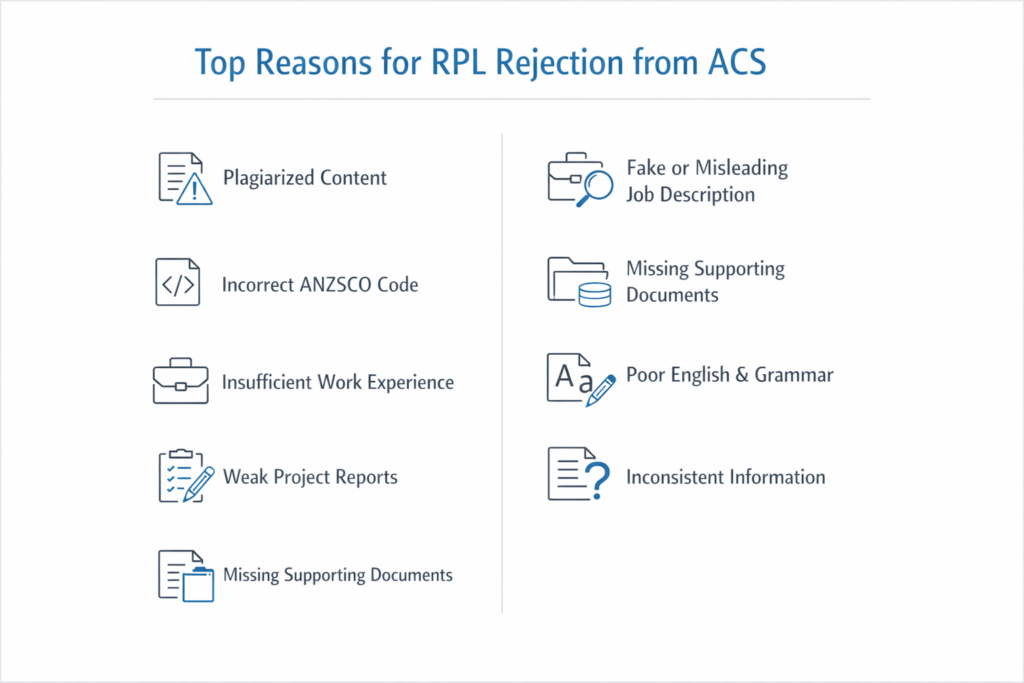
1. Plagiarized or Copied RPL Content
Plagiarism is the most common reason for ACS RPL rejection.
ACS uses advanced plagiarism detection tools (including Turnitin-style systems) to identify:
- Copied content from online samples
- Rewritten or paraphrased template reports
- AI-generated or repetitive content
- Reused content from previous submissions (self-plagiarism)
Even slight similarities can trigger rejection.
How to avoid this:
- Write all content based on your real experience
- Never copy sample RPL reports
- Use samples only for understanding structure
- Check originality before submission
2. Incorrect or Irrelevant ANZSCO Code Selection
Choosing the wrong ANZSCO code is a critical mistake that leads to rejection.
ACS expects your:
- Job role
- Project descriptions
- Key Areas of Knowledge.
- Employment evidence
to closely align with your nominated ANZSCO occupation.
Common mistakes include:
- Selecting a high-demand ANZSCO code without relevant duties
- Mismatch between job title and actual responsibilities
- Trying to “fit” experience into an unsuitable occupation
How to avoid this:
- Select an ANZSCO code that matches at least 65–70% of your duties
- Align projects and KAoK strictly with the chosen occupation
- Avoid exaggerating or reshaping roles unnaturally
3. Insufficient or Non-Assessable Work Experience
ACS has strict work experience requirements, and failing to meet them leads to rejection.
Your experience may be rejected if:
- Total experience duration is insufficient
- Employment periods overlap (concurrent employment)
- Experience is not relevant to ICT
- Experience lacks proper evidence
ACS only counts assessable and verifiable experience.
How to avoid this:
- Ensure you meet the minimum experience threshold
- Avoid overlapping employment periods
- Clearly define roles, timelines, and responsibilities
- Submit detailed reference letters and proof
4. Weak or Inadequate Project Reports
Your two project reports are the backbone of your RPL submission.
Common project-related rejection reasons include:
- Generic or vague task descriptions
- No clear mention of your personal role
- Lack of technical depth
- Projects not aligned with ANZSCO code
- Missing tools, technologies, or methodologies
ACS evaluates your individual contribution, not team achievements.
How to avoid this:
- Clearly define your role and responsibilities
- Include tools, platforms, languages, frameworks, and methods
- Explain problem-solving and decision-making
- Keep projects realistic and experience-based
5. Fake or Misleading Job Descriptions
Submitting false, exaggerated, or irrelevant job descriptions leads to immediate rejection.
ACS cross-checks:
- Job duties vs ANZSCO code
- RPL content vs reference letters
- Consistency across documents
Any mismatch raises red flags.
How to avoid this:
- Use accurate, verifiable job descriptions
- Match duties with your nominated occupation
- Avoid inflated titles or unrealistic achievements
6. Missing or Weak Supporting Documentation
Even a well-written RPL report can fail if supporting documents are missing or inconsistent.
Common documentation issues:
- Missing employment reference letters
- No company letterhead or signature
- Incorrect dates or job titles
- Mismatch between RPL and references
- Lack of payslips, contracts, or tax records
How to avoid this:
- Provide properly formatted reference letters
- Ensure consistency across all documents
- Add supporting evidence wherever possible
7. Poor English, Grammar, and Structure
ACS expects professional-level written English.
Reports may be rejected due to:
- Grammar and spelling errors
- Poor sentence structure
- Unclear explanations
- Unprofessional formatting
Poor writing affects clarity and credibility.
How to avoid this:
- Proofread thoroughly
- Maintain clear structure and headings
- Use professional technical language
- Get your report reviewed before submission
Consequences of ACS RPL Rejection
An ACS RPL rejection can result in:
- Delays in migration plans
- Financial loss
- Re-submission scrutiny
- Possible cooling-off period
- Complete report rewrite
That’s why getting it right the first time is crucial.
Expert Tips to Avoid ACS RPL Rejection
- Write 100% original, experience-based content
- Select the correct ANZSCO code
- Prepare detailed, technical project reports
- Align KAoK strictly with ACS guidelines
- Submit complete and consistent documentation
- Proofread and check plagiaris
- Seek professional guidance if unsure
Final Thoughts
The RPL pathway is a powerful opportunity for ICT professionals to migrate to Australia—but it comes with strict ACS standards. Most RPL rejections happen due to avoidable mistakes, not lack of skills. By understanding the Reasons for RPL Rejection from ACS and preparing a clear, compliant, and original report, you significantly improve your chances of approval. Your RPL report is more than a formality—it’s a professional reflection of your ICT career. Invest the time, effort, and accuracy it deserves.